
If you’re starting your financial journey in your 30s, 40s, or beyond, you’ve probably heard the standard advice: save 3-6 months of expenses for emergencies before investing a single dollar. But here’s what the traditional financial advice doesn’t tell you – this cookie-cutter approach can actually hurt late starters more than help them.
As someone who started my own financial turnaround later than I’d like to admit, I’ve learned that late starters face a unique challenge. We don’t have the luxury of spending years building a massive emergency fund while our investment opportunities slip away. We need a smarter, more strategic approach that protects us from emergencies without sabotaging our long-term wealth building.
Why Traditional Emergency Fund Advice Fails Late Starters
The conventional wisdom of saving 3-6 months of expenses assumes you have decades to build wealth. When you’re 25, spending two years building an emergency fund might be prudent. When you’re 40 with limited retirement savings, those same two years could cost you hundreds of thousands in lost compound growth.
The Opportunity Cost Reality
Let’s run the numbers. Say you’re 35 with $50,000 in annual expenses. The traditional advice suggests saving $12,500 to $25,000 before investing. If you’re able to save $1,000 monthly, that’s 13-25 months of emergency fund building with zero wealth accumulation.
But here’s what you’re really giving up: if you invested that $1,000 monthly for 30 years at a 7% return, you’d have approximately $1 million. Every year you delay investing costs you massive compound growth – something late starters can’t afford to lose.
The Stability Myth
The traditional emergency fund approach assumes your financial life is completely unstable without that full cushion. But if you’re in your 30s or 40s, you likely have more financial stability than a 22-year-old just starting out. You probably have:
- Established career skills and experience
- Professional networks and references
- Better understanding of your industry and job market
- Possibly multiple income streams or a working spouse
- Credit options (which I don’t recommend relying on, but they exist)
This stability means you need less cash sitting idle than someone with no professional experience or network.
The Late Starter’s Emergency Fund Strategy
After going through my own debt payoff and wealth-building journey, I’ve developed what I call the “Graduated Emergency Fund” approach for late starters. Instead of the traditional all-or-nothing method, this strategy builds emergency protection while simultaneously growing wealth.
Important Risk Considerations: This strategy requires honest self-assessment and financial discipline. You must be brutally realistic about your job security and comfortable with some market risk. If you tend toward financial anxiety or struggle with debt discipline, consider a more conservative approach.
Phase 1: The Starter Fund ($1,000-$2,500)
Your first priority is building a small starter emergency fund of $1,000 to $2,500. This isn’t meant to handle major emergencies – it’s designed to prevent small unexpected expenses from derailing your progress.
This amount should cover:
- Minor car repairs
- Small medical bills
- Appliance replacements
- Pet emergencies
- Small home repairs
The beauty of the starter fund is that you can build it quickly. Most people can accumulate $1,000-$2,500 in 1-3 months through a combination of:
- Selling unused items
- Taking on extra work or overtime
- Temporarily cutting discretionary spending
- Using tax refunds or bonuses
Phase 2: The Split Strategy (With Important Safeguards)
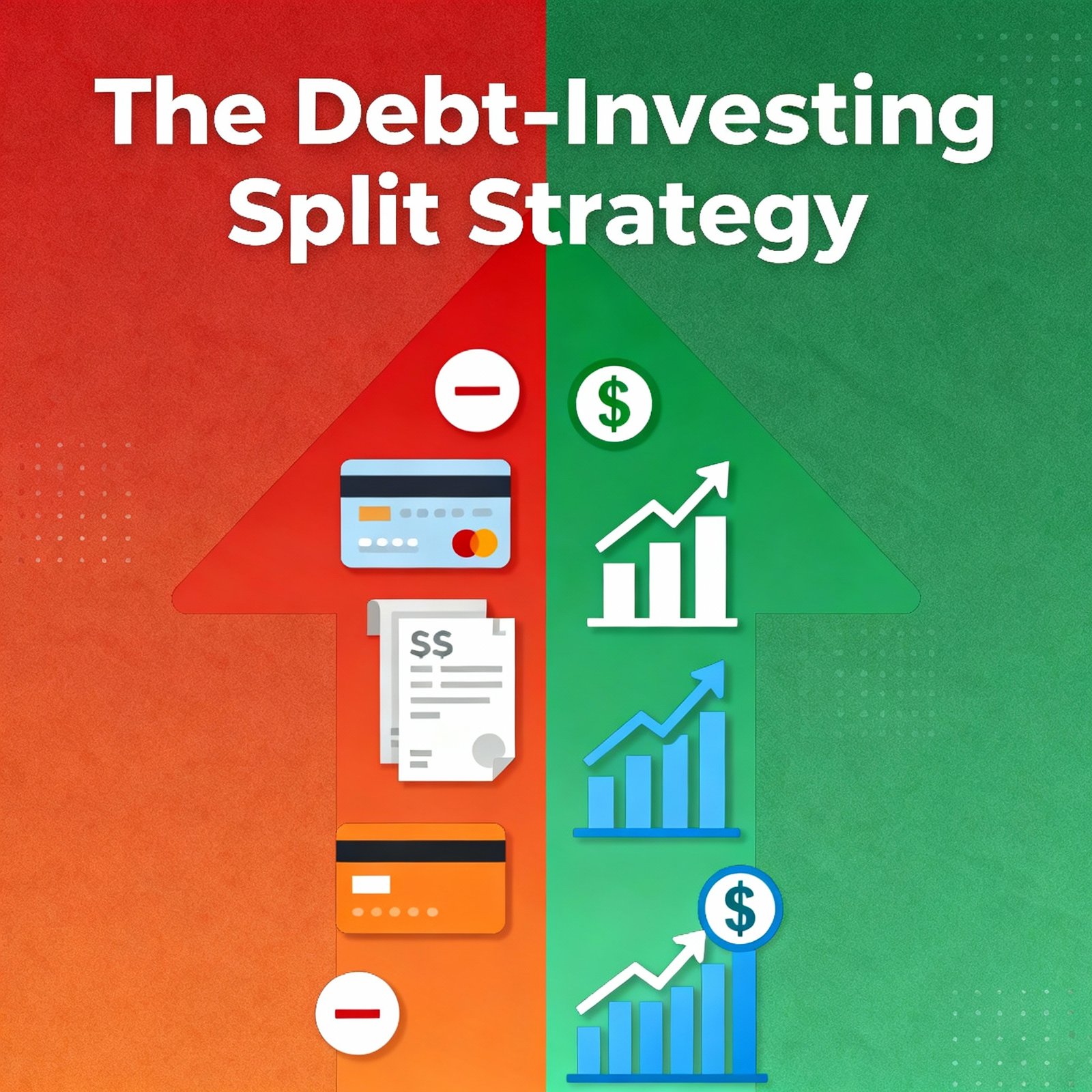
Once you have your starter fund, here’s where late starters diverge from traditional advice. Instead of continuing to pile money into savings until you reach 3-6 months of expenses, you start splitting your extra money between emergency savings and investments.
The 50/50 split rule: For every dollar you can save beyond your starter fund, put 50 cents toward emergency savings and 50 cents toward investments (preferably in tax-advantaged accounts like a 401k or IRA).
This approach accomplishes two critical goals:
- You’re still building emergency protection
- You’re not missing out on compound growth opportunities
Critical Risk Management: The split strategy assumes you may need to liquidate investments during market downturns. To minimize this risk:
- Keep investment portions in conservative allocations (60% stocks/40% bonds maximum)
- Never invest emergency fund portions in individual stocks or high-volatility assets
- Consider target-date funds or balanced funds for stability
- Understand you might face “liquidation regret” if forced to sell during market lows
Phase 3: The Full Fund (But It’s Smaller)
The target for your full emergency fund should be 2-3 months of essential expenses, not total expenses. There’s a crucial difference.
Essential expenses include:
- Housing (rent/mortgage, insurance, utilities)
- Transportation (car payment, insurance, gas)
- Food (groceries, not dining out)
- Insurance premiums
- Minimum debt payments
- Basic phone/internet
Non-essential expenses you can cut in an emergency:
- Dining out and entertainment
- Subscriptions and memberships
- Clothing and shopping
- Travel and vacations
- Hobbies and recreational activities
By focusing on essential expenses only, your emergency fund target drops significantly. If your total monthly expenses are $5,000 but your essentials are $3,000, you need $6,000-$9,000 rather than $15,000-$30,000.
Real-World Emergency Fund Scenarios
Let me share three scenarios from my own experience and observations to illustrate how this approach works in practice.
Scenario 1: The Job Loss
Sarah, 38, lost her marketing job unexpectedly. Her total monthly expenses were $4,200, but her essentials were only $2,800. With a 3-month essential emergency fund of $8,400, she had breathing room to:
- Take time to find a good job rather than accepting the first offer
- Maintain her essential lifestyle without panic
- Avoid touching her growing investment accounts
She found a new job in 10 weeks and used only $7,000 of her emergency fund. More importantly, her investments continued growing during this period, and she was able to replenish the emergency fund within 6 months.
Scenario 2: The Medical Emergency (Updated with Risk Awareness)
James, 42, faced a $4,500 medical bill after insurance. His starter fund covered the first $2,000, and he used a 0% promotional credit card for the remainder rather than liquidating investments or taking on high-interest debt.
The key detail: James immediately set up automatic payments to pay off the promotional balance in 11 months (leaving one month buffer before the promotional rate expired). He also confirmed he could cover the monthly payments from his regular income without touching his emergency fund. The payment plan cost him about $100 in interest over 18 months – far less than the opportunity cost of keeping an extra $4,500 in a savings account earning 1%.
Risk Warning: This strategy only works if you have the discipline to pay off promotional balances before rates spike (often to 24%+ APR). If you struggle with credit card debt or forget payment due dates, keep a larger cash emergency fund instead.
Scenario 3: The Home Repair
Lisa, 45, needed a new HVAC system costing $6,500. Her emergency fund covered $4,000, and she used a 0% promotional credit card for the remaining $2,500, which she paid off over 12 months. This allowed her to handle the emergency without touching investments or stopping her retirement contributions.
How to Size Your Emergency Fund
Here’s a practical framework for determining your ideal emergency fund size as a late starter:
Step 1: Calculate Essential Monthly Expenses
List only the expenses you couldn’t eliminate in an emergency:
- Housing costs: $______
- Transportation: $______
- Food (groceries): $______
- Insurance: $______
- Minimum debt payments: $______
- Other true necessities: $______
- Total Essential Monthly: $______
Step 2: Assess Your Stability Factors (Be Brutally Honest)
Rate your job/income stability on a scale of 1-5 (5 being most stable):
- Industry stability: ___
- Company stability: ___
- Your role’s importance: ___
- Specialized skills/experience: ___
- Network and references: ___
Total Score: ___/25
Warning: Be brutally honest in this assessment. Overestimating your job security could leave you vulnerable. Consider factors like:
- Is your industry facing automation or disruption?
- How has your company performed during recent economic stress?
- Could your role be eliminated or outsourced?
- Do you have skills that transfer to other companies/industries?
- When did you last actively network or job search?
If you’re uncertain about any factor, rate it lower rather than higher. Your financial security depends on accurate self-assessment.
Step 3: Determine Your Multiplier
- Score 20-25: Use 2x essential monthly expenses
- Score 15-19: Use 2.5x essential monthly expenses
- Score 10-14: Use 3x essential monthly expenses
- Score below 10: Consider traditional 3-6 months total expenses
Step 4: Your Target Emergency Fund
Essential Monthly Expenses × Your Multiplier = Target Emergency Fund $______ × ______ = $______
Critical Risk Management Considerations
Before implementing this strategy, understand these potential challenges:
The Market Timing Risk
The Problem: If you need emergency funds during a market downturn, you might be forced to sell investments at a loss. This “liquidation regret” can eliminate years of gains and undermine the strategy’s benefits.
The Solution:
- Keep any investment portion of your emergency strategy in conservative allocations (maximum 60% stocks)
- Consider using bond funds or balanced funds rather than pure stock investments
- Maintain at least 1-2 months of expenses in cash regardless of your stability score
- Accept that some market timing risk is the trade-off for compound growth
The Credit Discipline Requirement
The Problem: Using promotional credit cards or payment plans requires exceptional financial discipline. Missing payments or failing to pay off balances before promotional rates expire can result in 24%+ APR charges.
The Solution:
- Only use credit strategies if you have a perfect track record with credit card payments
- Set up automatic payments immediately when using promotional rates
- Always aim to pay off promotional balances 1-2 months before the promotional period ends
- Have a backup plan if you can’t make the payments from regular income
The Stability Assessment Challenge
The Problem: Most people overestimate their job security and underestimate economic risks. This can lead to inadequate emergency protection.
The Solution:
- Ask trusted colleagues or mentors to review your stability assessment
- Research your industry’s layoff patterns during recessions
- Consider worst-case scenarios when rating your stability
- Review and update your assessment annually or after major economic changes
The Psychology of a Right-Sized Emergency Fund (And When It Might Not Work)
One concern many late starters have about smaller emergency funds is psychological – will I sleep at night with “only” $8,000 in emergencies rather than $25,000? In my experience, the answer is usually yes, but not always. Here’s what to consider:
When Smaller Emergency Funds Work Psychologically
Growing Wealth Provides Security: As your investment accounts grow, they provide a different type of security. While you shouldn’t treat investments as emergency funds, knowing you have $50,000 in retirement accounts provides psychological comfort, even if it’s not immediately accessible.
You Develop Financial Confidence: The process of successfully managing money – paying off debt, building investments, handling small emergencies – builds confidence in your ability to navigate financial challenges. You realize you’re more resourceful and capable than you thought.
Opportunity Cost Anxiety: After understanding the true cost of over-saving, many late starters develop “opportunity cost anxiety” – they become more worried about missing investment growth than about having a smaller emergency fund. This shift in mindset is actually healthy for wealth building.
When You Might Need a Larger Fund
High Financial Anxiety: If a smaller emergency fund causes constant worry that affects your sleep, work performance, or decision-making, you might need a larger cash cushion regardless of the math. Chronic financial stress can be more costly than missed investment opportunities.
Risk-Averse Personality: Some people genuinely cannot feel secure with market-based emergency backup strategies. If you’re highly risk-averse, a traditional 3-6 month fund might be worth the opportunity cost for your peace of mind.
Complex Family Situations: Multiple dependents, aging parents, special needs family members, or other complex responsibilities might warrant larger emergency funds despite the opportunity cost.
Self-Assessment Question: Ask yourself honestly: “Would I rather have $25,000 in cash or $15,000 in cash plus $50,000 in growing investments after five years?” If you’d genuinely prefer the all-cash option, this strategy isn’t right for you.
Common Mistakes to Avoid
Mistake 1: Perfectionism Paralysis
Don’t wait until you have the “perfect” emergency fund before investing. Start with your starter fund and begin the split strategy immediately. Done is better than perfect when you’re racing against time.
Mistake 2: Lifestyle Inflation
As your income grows, resist the urge to inflate your emergency fund target. If your essential expenses remain stable, your emergency fund can remain stable too. Put income increases toward investments instead.
Mistake 3: High-Yield Account Obsession
Don’t spend excessive time optimizing emergency fund returns. The difference between 1% and 4% on $10,000 is $300 annually – meaningful, but not worth the complexity of constantly chasing rates or multiple accounts.
Mistake 4: Credit Substitution
Never treat credit cards or lines of credit as emergency funds. They should be backup options only. The goal is to avoid debt in emergencies, not rely on it.
Building Your Emergency Fund Efficiently
The Fast Track Method (1-3 months)
If you want to build your starter fund quickly:
Sell and Simplify:
- Unused electronics, furniture, clothing
- Books, movies, games you won’t use again
- Exercise equipment gathering dust
- Extra vehicles or recreational items
Earn Extra:
- Overtime or extra shifts
- Freelance work in your expertise area
- Gig economy work (driving, delivery, task-based)
- One-time service projects
Temporary Cuts:
- Cancel subscriptions for 2-3 months
- Eat out less and meal prep more
- Postpone non-essential purchases
- Use free entertainment options
The Steady Build Method (6-12 months)
If you prefer a more gradual approach:
- Automate $200-500 monthly to emergency fund
- Use windfalls (tax refunds, bonuses, gifts)
- Save one month’s worth every 2-3 months
- Track progress and celebrate milestones
When to Adjust Your Emergency Fund
Your emergency fund isn’t set in stone. Adjust it when:
Life Changes
- Job change (more or less stable)
- Marriage or divorce
- Having children
- Major health changes
- Home ownership changes
Financial Changes
- Debt payoff (reduces essential expenses)
- Income increases or decreases
- New insurance coverage
- Investment account growth reaching significant levels
Market Conditions
- Economic uncertainty might warrant temporarily higher fund
- Personal industry challenges
- Unusual family circumstances
Advanced Strategies for Late Starters
The Roth IRA Emergency Fund
One advanced strategy is using a Roth IRA as a dual-purpose emergency fund. You can withdraw Roth IRA contributions (not earnings) penalty-free at any time. This allows your emergency fund to grow tax-free while remaining accessible.
Example: Instead of keeping $10,000 in a 1% savings account, you could keep $5,000 in savings and $5,000 in Roth IRA contributions invested in conservative funds. The Roth portion grows tax-free but remains accessible for true emergencies.
The Taxable Investment Bridge
For very stable employment situations, some late starters keep a smaller cash emergency fund (1-2 months essentials) and a larger taxable investment account in conservative investments. This isn’t right for everyone, but it can work for those with strong job security.
The HELOC Backup
If you own a home with equity, a Home Equity Line of Credit (HELOC) can serve as emergency backup rather than primary protection. You pay no interest unless you use it, and it’s there if your cash emergency fund proves insufficient.
The Bottom Line for Late Starters
The traditional emergency fund advice was written for people starting their careers at 22 with 40+ years to build wealth. If you’re starting later, you need a different strategy that balances protection with growth opportunities.
Your emergency fund should be large enough to provide security but small enough that you’re not sabotaging your wealth building. For most late starters, this means:
- Start with $1,000-$2,500 immediately
- Build to 2-3 months of essential expenses (not total expenses)
- Use the split strategy to build emergency funds while investing
- Adjust based on your personal stability factors
- Don’t let perfect be the enemy of good
Remember, the goal isn’t to never face financial challenges – it’s to handle them without derailing your long-term financial progress. A right-sized emergency fund gives you that protection while keeping you on track for the wealth building that’s crucial when you’re starting later in life.
The clock is ticking, but it’s not too late. By building smart emergency protection rather than excessive cash hoarding, you can catch up faster than you think possible.
About Calvin Nate: I’m a certified financial controller who started my own financial transformation later than I’d like to admit. Through ItIsNotLate.com, I share practical strategies for fellow late starters who want to catch up without the complexity and confusion of traditional financial advice. It’s never too late to take control of your financial future.






Leave a Reply