
It was 2:15 AM when Jennifer, 44, closed her laptop in frustration. She’d spent three hours researching debt payoff calculators and investment return projections, trying to decide what to do with an extra $800 monthly. The math said one thing, but her gut said another. Her $24,000 in student loans at 5.2% could theoretically wait while she invested for retirement catch-up. But every time she thought about owing money while putting cash into the stock market, her chest tightened.
Sound familiar?
In my role as a financial controller, I’ve analyzed countless budgets and financial scenarios. But through my personal finance journey and helping others navigate theirs, I’ve discovered something the spreadsheets don’t capture: psychological factors often override mathematical logic. And for late starters, these emotional elements can either propel you toward financial success or paralyze you indefinitely.
This isn’t about dismissing the math—it’s about understanding why smart, capable people often ignore optimal strategies. More importantly, it’s about working with your psychology, not against it, to build lasting wealth.
The Hidden Cost of Financial Decision Paralysis
The Neuroscience of Money Stress
Recent research from Stanford’s Financial Psychology Lab shows that financial stress literally changes how our brains function. When you’re carrying debt or feeling behind financially, your brain shifts into what researchers call “scarcity mode.” This state reduces cognitive bandwidth by as much as 13 IQ points—equivalent to losing a full night’s sleep.
The real-world impact: You become less capable of making the very decisions that could improve your situation. It’s not laziness or lack of intelligence—it’s your brain protecting itself from perceived threats.
Decision Fatigue: Why Smart People Make No Decision
Dr. Sarah Chen’s 2024 study at the University of Chicago followed 847 adults facing debt vs. investing decisions. The most surprising finding? 68% of participants made no decision at all during the six-month study period. They researched, calculated, and worried—but never acted.
The pattern was clear among late starters:
- Weeks 1-2: Intense research and calculation
- Weeks 3-6: Analysis paralysis sets in
- Months 2-6: Gradual retreat from financial planning altogether
Real-world example: The Research Trap
At 41, one person I know spent eight months “researching the perfect strategy” for $18,000 in student loans versus investing for retirement. During those eight months, they did nothing. When we finally implemented a simple 60/40 split strategy, they said, “I wasted more money overthinking this than I would have lost making the ‘wrong’ choice.”
The Emotional Weight of Debt: More Than Numbers on a Statement
Debt Shame and the Isolation Trap
Financial psychologist Dr. Brad Klontz’s research reveals that 79% of people experience what he terms “financial shame” around debt. This shame creates a dangerous isolation loop:
- Shame leads to secrecy (not discussing financial struggles)
- Secrecy leads to isolation (feeling like you’re the only one struggling)
- Isolation leads to inaction (believing your situation is uniquely hopeless)
Breaking the cycle: In my experience, the single most powerful intervention is often the simplest—realizing you’re not alone. When people understand that 77% of Americans carry some form of non-mortgage debt (Federal Reserve, 2024), the shame begins to lift.
The Debt Identity Trap
Here’s something most financial advice misses: debt often becomes part of your identity. You stop being “a person who happens to have debt” and become “a debtor.” This psychological shift is profound because identity drives behavior.
Example: The Identity Shift
One person I worked with, Tom, 48, referred to himself as “drowning in debt” with $31,000 in various obligations. His actual debt-to-income ratio was 23%—completely manageable. But the identity of being “financially doomed” prevented him from taking any positive action for two years.
The reframe that changed everything: We shifted his language from “I’m terrible with money” to “I’m learning to optimize my financial strategy.” This wasn’t positive thinking fluff—it was identity reconstruction that enabled action.
The Late Starter’s Unique Psychological Challenges
Regret Amplification and the “Lost Years” Trap
Late starters face a psychological burden that 25-year-olds don’t: amplified regret. Every article about compound interest, every retirement calculator showing what you “should” have by now, reinforces a painful narrative of missed opportunities.
The neuroscience: Regret activates the same brain regions as physical pain. For late starters, financial planning can literally hurt, which explains why many avoid it entirely.
The Comparison Trap: Social Media and Financial FOMO
A 2025 study by the American Psychological Association found that 43% of adults over 35 experience “financial FOMO” triggered by social media. Seeing peers post about investment gains, home purchases, or retirement planning can trigger what researchers call “temporal social comparison”—feeling behind relative to others your age.
The solution: Understand that social media shows highlight reels, not struggles. That colleague posting about their portfolio gains isn’t sharing their credit card debt or sleepless nights about money.
The Satisfaction Psychology of Debt Elimination
The Neurobiology of Debt Freedom
When you pay off debt completely, your brain releases dopamine—the same neurotransmitter triggered by winning at gambling or receiving likes on social media. This creates what psychologists call “completion satisfaction,” which is often more powerful than the gradual wealth building from investing.
This explains the debt snowball phenomenon: Even though paying off smallest balances first (rather than highest interest rates) is mathematically suboptimal, it works psychologically. Each payoff creates a neurochemical reward that motivates continued action.
The Psychological Weight of Obligation
Debt represents future obligation—a psychological burden that affects decision-making across all areas of life. Research shows that people carrying debt make more risk-averse choices, even in unrelated situations. They’re more likely to:
- Choose guaranteed small rewards over uncertain large ones
- Avoid career risks that could increase income
- Delay major life decisions (home buying, family planning)
The liberation effect: When people eliminate debt entirely, I often see dramatic changes in their willingness to take positive risks—pursuing promotions, starting businesses, or making bold investment moves.
Working WITH Your Psychology: Practical Strategies
The “Emotional Portfolio” Approach
Just as you diversify investments, diversify your emotional satisfaction:
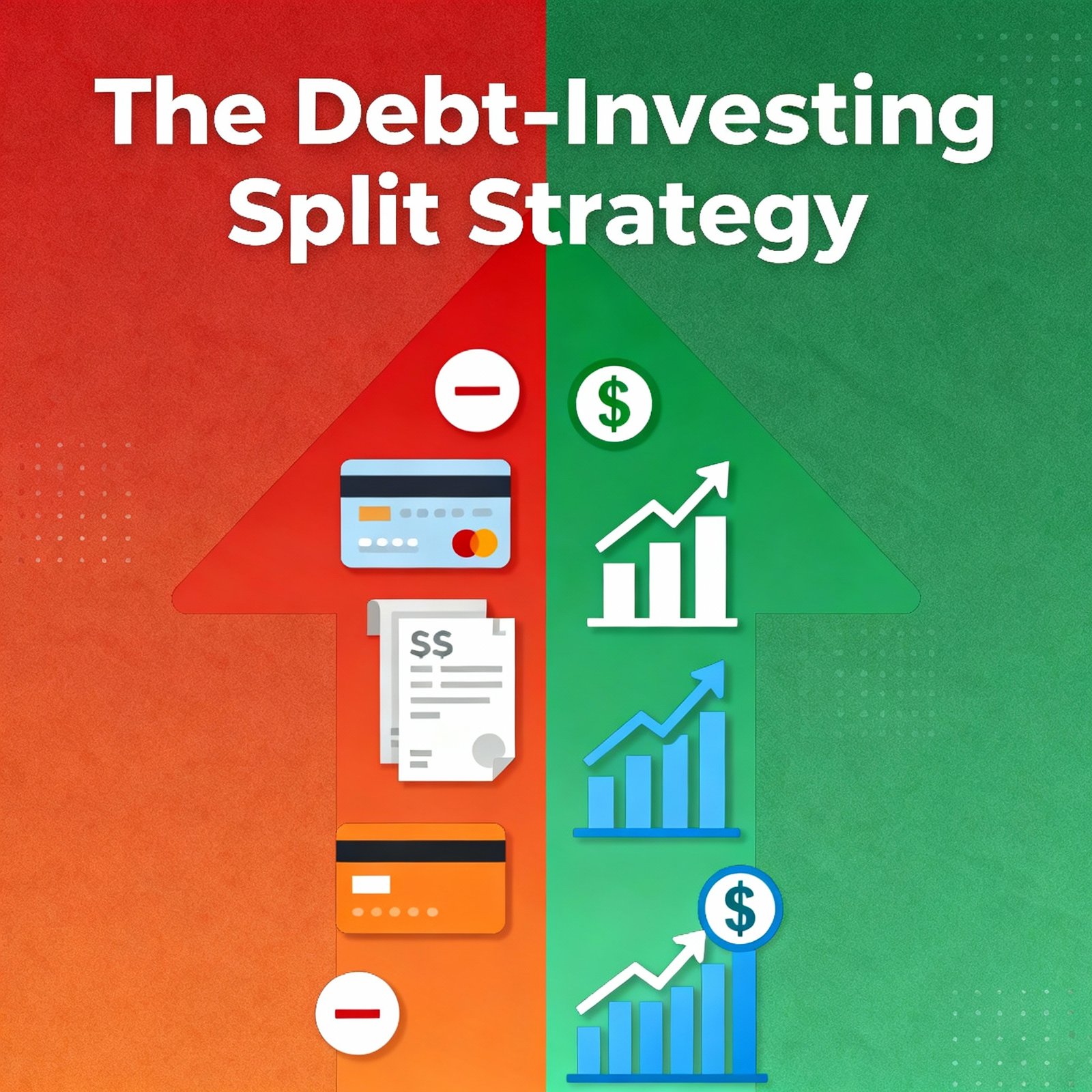
60% Logic, 40% Emotion Strategy:
- Use 60% of extra funds for mathematically optimal choices
- Use 40% for psychologically satisfying moves (like eliminating a small debt)
This hybrid approach acknowledges both your rational and emotional needs.
The “Progress Ritual” Method
Create specific rituals around financial progress to trigger positive neurochemical responses:
- Monthly victories: Celebrate every debt payment or investment contribution, no matter how small
- Visual progress: Use debt thermometers or investment growth charts
- Social accountability: Share milestones with a trusted friend or financial community
The “Future Self” Visualization Technique
Research from UCLA shows that people who vividly visualize their future selves make better long-term financial decisions.
Exercise: Spend 10 minutes monthly visualizing yourself at retirement—not just the numbers, but the lifestyle, freedom, and peace of mind. This makes future benefits feel more real than present sacrifices.
Advanced Psychological Strategies for Late Starters
The “Minimum Viable Progress” Principle
Perfectionism is the enemy of progress, especially for late starters who feel pressure to make up for lost time. Instead of optimal strategies that you won’t execute, choose “minimum viable progress” that you will actually maintain.
Examples:
- Automated $100 monthly investment vs. perfect market timing with $0 invested
- Paying off one small debt vs. optimal avalanche method that you abandon
- Simple target-date fund vs. complex portfolio you never rebalance
The “Identity Bridging” Technique
Help your brain transition from “financially behind” to “building wealth” by creating bridge identities:
- Current identity: “I’m bad with money”
- Bridge identity: “I’m learning financial strategy”
- Target identity: “I’m building wealth systematically”
Each small financial action reinforces the bridge identity, gradually shifting your self-concept.
Creating Your Psychologically Sustainable Financial Plan
The Integration Framework
Your financial plan must integrate both mathematical optimization and psychological sustainability:
Mathematical factors:
- Interest rates and expected returns
- Tax implications
- Time horizons
Psychological factors:
- Your money personality and triggers
- What motivates you to continue
- Your specific fears and concerns
The “Psychological Emergency Fund”
Beyond your financial emergency fund, create a “psychological emergency fund”—strategies for when emotional obstacles threaten your progress:
- When overwhelmed: Focus only on automated minimum actions
- When discouraged: Review your progress visually and celebrate small wins
- When tempted to quit: Connect with your future self visualization
- When comparing to others: Remember your unique situation and timeline
Common Psychological Pitfalls and Solutions
Pitfall 1: All-or-Nothing Thinking
Problem: “I must pay off ALL debt before investing anything”
Solution: Hybrid approaches that address both goals simultaneously
Pitfall 2: Comparison Paralysis
Problem: Constantly comparing your situation to others
Solution: Focus on your personal progress metrics, not others’ highlight reels
Pitfall 3: Perfect Timing Obsession
Problem: Waiting for ideal market conditions or life circumstances
Solution: Understand that “good enough” started beats “perfect” delayed
Pitfall 4: Catastrophic Thinking
Problem: Assuming any setback means total failure
Solution: Build flexibility into your plan and normalize temporary obstacles
The Path Forward: Your Psychological Action Plan
Week 1: Awareness Building
- Identify your primary financial fears and psychological obstacles
- Recognize which emotions drive your money decisions
- Acknowledge regrets without letting them paralyze action
Week 2: Strategy Selection
- Choose a debt/investing approach that feels sustainable, not necessarily optimal
- Set up automated systems to reduce decision fatigue
- Create accountability measures (friend, app, visual tracker)
Week 3: Identity Work
- Begin shifting from “behind” identity to “building” identity
- Practice future self visualization
- Celebrate first small actions
Month 2 and Beyond: Momentum Building
- Review and adjust based on what’s actually working
- Gradually increase contributions as psychological comfort grows
- Continue reinforcing positive financial identity
Conclusion: Your Psychology Is Your Superpower
The traditional financial advice industry treats psychology as an obstacle to overcome. I’ve learned it’s actually your greatest asset when properly channeled. Your emotions, fears, and motivations aren’t bugs in your financial system—they’re features that, when understood and integrated, create sustainable long-term success.
The mathematical “perfect” strategy that you abandon after two months is inferior to the psychologically sustainable “good enough” strategy you maintain for decades. This is especially true for late starters, who need consistency more than perfection.
Stop fighting your psychology. Start working with it. Your future self—and your bank account—will thank you for making decisions that honor both your rational mind and your human heart.
Remember: You don’t need perfect timing, perfect knowledge, or perfect discipline. You just need to start, with a strategy that acknowledges both who you are mathematically and who you are emotionally.
The best financial plan isn’t the one that looks perfect on paper. It’s the one you’ll actually follow.
Disclaimer: This guidance is for educational purposes and doesn’t replace personalized financial advice. Individual circumstances and psychological factors vary significantly. Consider consulting with both a qualified financial advisor and a financial therapist if emotional obstacles significantly impact your financial decisions.
Sources:
- Federal Reserve Survey of Consumer Finances (2024)
- Stanford Financial Psychology Lab Research
- American Psychological Association Financial Stress Studies (2025)
- University of Chicago Decision-Making Research (Dr. Sarah Chen, 2024)
- UCLA Future Self Visualization Studies






Leave a Reply