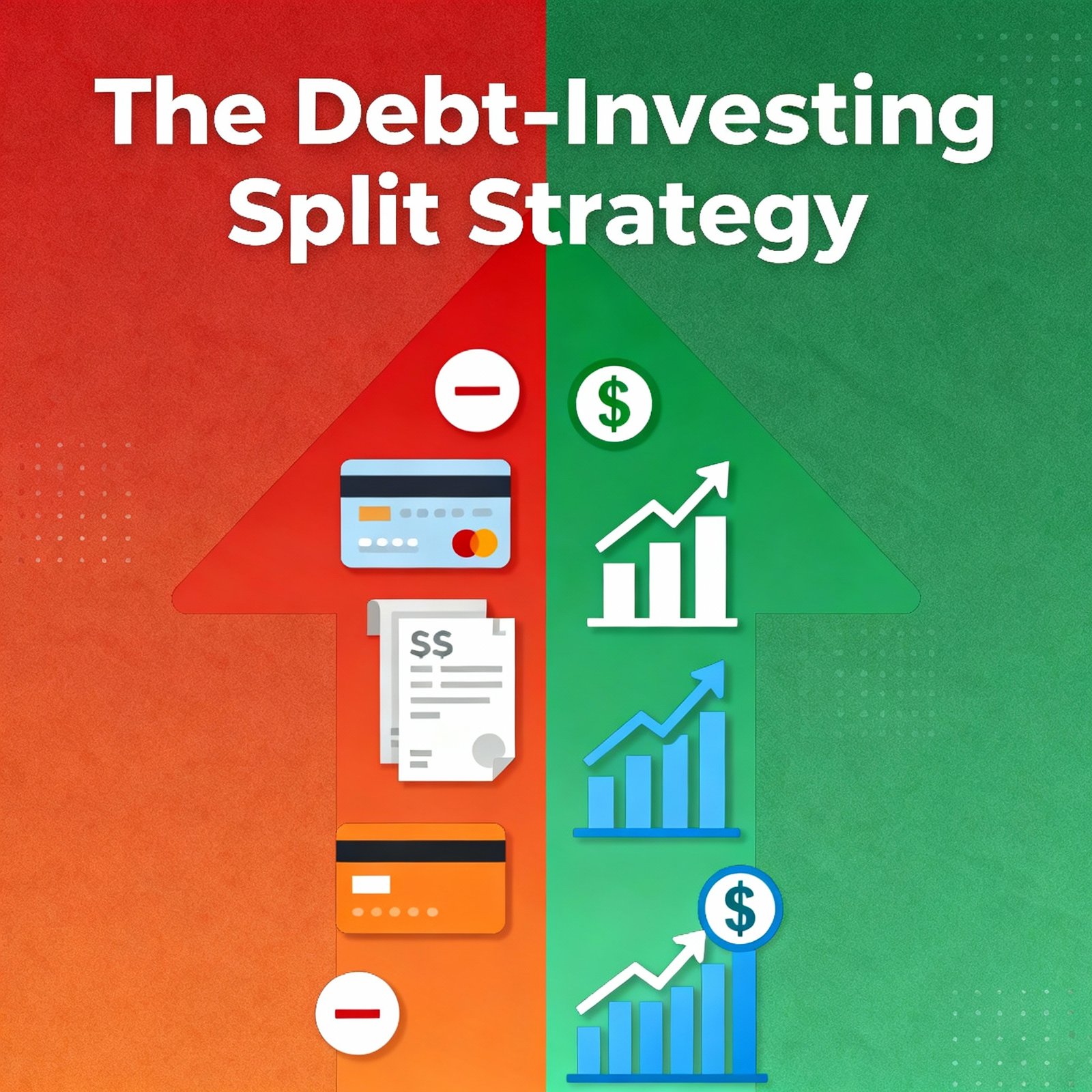
Starting your financial journey later in life can feel overwhelming, especially when facing the dual challenge of paying down debt while building wealth for the future. The debt-investing split strategy offers a practical framework that allows late starters to tackle both goals simultaneously, maximizing every extra dollar for long-term financial success.
This strategic approach moves beyond the traditional “pay off debt first” versus “invest first” debate by recognizing that late starters often can’t afford to focus on just one financial goal. Time is precious when you’re starting later, and the debt-investing split strategy helps you make the most of both your money and your years.
Why Traditional Debt vs. Investment Advice Fails Late Starters
Most financial advice assumes you’re starting your wealth-building journey in your twenties or thirties with decades ahead of you. This conventional wisdom typically falls into two camps: the debt-first advocates who insist you must eliminate all debt before investing, and the invest-first proponents who argue that historical market returns will always beat debt interest rates.
Both approaches have merit for traditional timelines, but they often fail late starters who face unique challenges. When you’re beginning your financial transformation at 40, 50, or beyond, you can’t afford to wait years to start building wealth, nor can you ignore high-interest debt that’s eroding your financial foundation.
The Problems with Debt-First Approaches for Late Starters
The debt-first strategy tells you to pay off all debts before investing a single dollar. While this creates a clean financial slate, it can be devastating for late starters. If you’re 45 and have $30,000 in various debts, spending three to five years focused solely on debt elimination means you’ll start investing at 48 or 50 – leaving you with limited time for compound growth.
Additionally, the psychological burden of seeing no investment progress for years can be demoralizing. Late starters need to see forward momentum on wealth building to stay motivated throughout their financial transformation.
Why Invest-First Strategies Often Backfire
On the flip side, the invest-first approach tells you to make minimum debt payments while putting extra money into investments. The mathematical argument seems sound: if your debt carries 6% interest but the stock market averages 10% returns, you should invest the difference.
However, this strategy ignores the psychological and practical realities late starters face. High-interest debt creates stress and financial instability that can derail your entire plan. More importantly, investment returns aren’t guaranteed, while debt payments are mandatory. A market downturn can leave you with both losses and mounting debt payments.
Understanding the Debt-Investing Split Strategy
The debt-investing split strategy provides a middle path that addresses both debt elimination and wealth building simultaneously. Rather than choosing one goal over the other, you allocate your extra money between both based on specific criteria that maximize your financial progress.
This approach recognizes that different types of debt require different strategies, and your allocation should be based on interest rates, tax implications, and your overall financial situation. The result is a personalized plan that reduces debt while building investment assets, creating momentum on both fronts.
The Psychology Behind Simultaneous Progress
One of the most powerful aspects of the debt-investing split is its psychological impact. When you’re making progress on both debt elimination and wealth building, you maintain motivation and momentum. Watching your net worth improve from both sides – decreasing debt and increasing investments – provides the emotional fuel needed for long-term success.
This dual progress also helps late starters feel like they’re “catching up” rather than just treading water. Instead of spending years focused solely on cleaning up past financial mistakes, you’re actively building your future while addressing your past.
How to Implement the Debt-Investing Split Strategy
The key to successful implementation lies in understanding how to categorize your debts and determine the optimal allocation for your situation. This systematic approach ensures you’re making mathematically sound decisions while maintaining psychological momentum.
Step 1: Categorize Your Debts by Interest Rate
Begin by listing all your debts with their respective interest rates, minimum payments, and balances. Group them into three categories:
High-Interest Debt (8%+ interest): Credit cards, personal loans, payday loans, and other high-cost debt fall into this category. According to Federal Reserve data, the average credit card interest rate currently exceeds 20%, making these debts a priority in your allocation strategy.
Moderate-Interest Debt (4-8% interest): This includes some personal loans, higher-rate auto loans, and non-deductible debt with moderate rates. These debts require a balanced approach in your split strategy.
Low-Interest Debt (Under 4% interest): Mortgages, low-rate auto loans, and subsidized student loans often fall here. The Consumer Financial Protection Bureau notes that these debts often have tax advantages, making them even more favorable when compared to investment opportunities.
Step 2: Determine Your Extra Money Available
Calculate how much money you have available each month beyond your essential expenses and minimum debt payments. This “extra money” forms the foundation of your debt-investing split strategy. Be realistic in this calculation – it’s better to start with a conservative amount you can consistently maintain than to overestimate and fall short.
Consider seasonal variations in your income and expenses. If your extra money varies significantly month to month, use your average monthly surplus or base your plan on your lowest months to ensure sustainability.
Step 3: Apply the Split Framework
Once you understand your debt categories and available extra money, apply the following allocation framework:
For High-Interest Debt: Allocate 70-80% of your extra money toward eliminating these debts aggressively. The remaining 20-30% goes toward investments to maintain wealth-building momentum.
For Moderate-Interest Debt: Use a 50-50 split, dividing your extra money equally between debt payments and investments. This balanced approach addresses debt while building wealth at a meaningful pace.
For Low-Interest Debt: Reverse the high-interest allocation by putting 70-80% toward investments and 20-30% toward extra debt payments. This maximizes your wealth-building potential while still making progress on debt elimination.
Step 4: Adjust Based on Your Personal Factors
The framework provides a starting point, but your personal situation may require adjustments. Consider factors such as job security, age, risk tolerance, and existing retirement savings when fine-tuning your allocation.
If you have extremely limited time until retirement, you might weight investments more heavily even with moderate-interest debt. Conversely, if high-interest debt is creating significant financial stress, you might allocate more aggressively toward debt elimination until it’s manageable.
Real-World Example: Sarah’s Debt-Investing Split
Sarah, a 47-year-old marketing manager, discovered this strategy when facing $45,000 in various debts while having only $2,000 in retirement savings. Her situation demonstrates how the debt-investing split can work in practice.
Sarah’s Debt Inventory:
- Credit card debt: $18,000 at 19% interest (minimum payment: $450)
- Personal loan: $12,000 at 7% interest (minimum payment: $280)
- Car loan: $15,000 at 3.5% interest (minimum payment: $320)
Sarah’s Available Extra Money: $800 per month after all essential expenses and minimum payments.
Sarah’s Split Strategy: For her high-interest credit card debt, Sarah allocated $560 (70%) of her extra money toward additional payments while investing $240 (30%) in a diversified index fund portfolio.
Once the credit card debt was eliminated after 18 months, she tackled the personal loan with a 50-50 split: $400 toward extra payments and $400 toward investments.
Finally, with only the low-interest car loan remaining, Sarah shifted to an 80-20 split favoring investments: $640 toward her portfolio and $160 toward extra car payments.
Results After Three Years:
- Total debt reduced from $45,000 to $8,000 (car loan only)
- Investment portfolio grew to $28,000
- Net worth improvement: $65,000
- Monthly investment capacity increased to $800 as debt payments decreased
Sarah’s transformation demonstrates how the debt-investing split creates momentum on both fronts while building the discipline needed for long-term financial success.
Advanced Strategies for Optimizing Your Split
As you become comfortable with the basic debt-investing split framework, several advanced strategies can help you optimize your results and adapt to changing circumstances.
Tax-Advantaged Account Prioritization
When allocating money toward investments, prioritize tax-advantaged accounts that provide immediate benefits. The IRS guidelines for 401(k) contributions show that maximizing your employer match should typically take precedence, as the match represents an immediate 100% return on investment.
After securing your full employer match, consider whether additional 401(k) contributions or IRA contributions make sense based on your tax situation and debt interest rates. The tax savings from these contributions can effectively reduce the “cost” of choosing investments over debt payments.
The Emergency Fund Consideration
Traditional advice suggests building a full emergency fund before addressing debt or investments, but this approach can paralyze late starters. Research from the National Endowment for Financial Education shows that most Americans struggle to save even $1,000 for emergencies, making the traditional “three to six months” recommendation unrealistic for many late starters. Instead, consider building a small starter emergency fund ($1,000-$2,500) while implementing your debt-investing split.
As your debt decreases and your financial stability improves, gradually build your emergency fund to three to six months of expenses. This approach prevents emergencies from derailing your progress while not delaying your wealth-building efforts.
Refinancing and Debt Consolidation Opportunities
Regularly evaluate opportunities to refinance or consolidate debt to improve your split strategy effectiveness. Moving high-interest debt to lower-interest options can shift money from the debt elimination category to wealth building.
However, be cautious about consolidation options that extend repayment terms significantly or require fees that negate the interest savings. The goal is to improve your overall financial position, not just reduce monthly payments.
Common Mistakes to Avoid with the Debt-Investing Split
While the debt-investing split strategy is powerful, several common mistakes can undermine its effectiveness. Recognizing and avoiding these pitfalls will help ensure your strategy’s success.
Mistake 1: Ignoring the Math in Favor of Emotions
Some late starters become so focused on debt elimination that they continue aggressive debt payments even on low-interest debt while neglecting investment opportunities. Remember that the strategy requires discipline to follow the mathematical framework, even when emotions push you toward debt elimination.
Conversely, don’t let investment enthusiasm cause you to underweight high-interest debt elimination. The guaranteed “return” from paying off high-interest debt often exceeds potential investment returns.
Mistake 2: Failing to Adjust as Circumstances Change
Your debt-investing split should evolve as your financial situation changes. As you eliminate high-interest debt, failing to shift allocation toward investments means missing opportunities for wealth building.
Similarly, if you experience income changes or new debt, adjust your strategy accordingly rather than rigidly following an outdated plan.
Mistake 3: Choosing Overly Complex Investments
When starting your investment portion of the split, keep things simple. Complex investments, individual stocks, or trendy investment strategies can distract from your main goal and potentially lead to losses.
Stick to low-cost, diversified index funds or target-date funds until your investment knowledge and account balance warrant more sophisticated strategies. Morningstar research consistently shows that low-cost index funds outperform the majority of actively managed funds over long periods.
Measuring Success and Staying Motivated
The debt-investing split strategy requires consistent execution over multiple years, making it essential to track progress and maintain motivation throughout your journey.
Key Metrics to Monitor
Track both sides of your financial equation monthly. Monitor your total debt balance, investment account values, and overall net worth. Seeing progress on all fronts helps maintain motivation during challenging months.
Create a simple spreadsheet or use apps like Personal Capital or YNAB that aggregate your accounts to visualize your progress. Watching your net worth line trend upward despite having debt provides powerful psychological reinforcement.
Celebrating Milestones
Establish meaningful milestones and celebrate achieving them. This might include eliminating your first high-interest debt, reaching your first $5,000 in investments, or achieving a positive net worth.
These celebrations don’t need to be expensive or elaborate – the key is acknowledging progress and reinforcing the positive behaviors that got you there.
Adjusting Expectations Realistically
Late starters often feel pressure to “catch up” quickly, leading to unrealistic expectations about progress. Remember that building wealth is a marathon, not a sprint, and consistent progress over time creates significant results.
Focus on the controllable aspects of your strategy – your savings rate, debt payments, and investment consistency – rather than market performance or factors outside your control.
When to Modify Your Strategy
While the debt-investing split provides a robust framework, certain circumstances may require strategy modifications to optimize your results.
Major Life Changes
Job loss, career changes, health issues, or family situations may require temporary adjustments to your split. During uncertain times, you might shift more heavily toward debt elimination to reduce fixed obligations, or you might pause extra debt payments to build a larger emergency fund.
The key is recognizing these situations as temporary adjustments rather than permanent strategy abandonment.
Market Conditions and Interest Rate Changes
Significant changes in market conditions or interest rates may warrant strategy adjustments. If interest rates rise substantially, refinancing opportunities might shift debt between categories. If markets experience significant volatility, you might temporarily adjust your allocation until conditions stabilize.
However, avoid making frequent changes based on short-term market movements. The strategy’s power comes from consistent long-term execution, not perfect market timing.
Building Long-Term Wealth Beyond the Split Strategy
The debt-investing split strategy serves as a foundation for building long-term wealth, but it’s not the end goal. As you eliminate debt and build investment assets, your financial strategy should evolve to focus increasingly on wealth building and preservation.
Transitioning to Wealth Building Focus
Once you’ve eliminated high-interest debt and established a solid investment foundation, you can gradually shift toward more aggressive wealth-building strategies. This might include increasing your investment rate, diversifying into different asset classes, or exploring tax optimization strategies.
The discipline and knowledge you’ve built through the split strategy provides an excellent foundation for these more advanced wealth-building techniques.
Planning for Retirement as a Late Starter
Late starters face unique retirement planning challenges that require specific strategies beyond the debt-investing split. The Social Security Administration provides detailed information about how delayed retirement affects benefits, which may be relevant for your planning. You may need to plan for a later retirement age, consider part-time work during early retirement, or explore catch-up contribution options for retirement accounts.
The debt-investing split strategy helps establish the foundation for these retirement planning strategies by eliminating debt and building initial investment assets.
Taking Action: Your Next Steps
Understanding the debt-investing split strategy is only the beginning – success comes from implementation and consistent execution. Start by gathering your financial information and creating your personalized split plan.
Begin with your debt inventory, calculating your available extra money, and determining your initial allocation. Remember that perfection isn’t required – starting with a reasonable plan and adjusting as you learn is better than delaying while trying to create the perfect strategy.
The most important step is the first one. Late starters who take action consistently, even with imperfect plans, achieve significantly better results than those who spend months planning without implementing.
Your financial transformation won’t happen overnight, but the debt-investing split strategy provides a clear path forward. Every dollar you allocate strategically brings you closer to financial security and the peace of mind that comes with taking control of your financial future.
Ready to transform your financial future? Start by listing your debts and available extra money today. Your future self will thank you for taking action now, regardless of how late you think you’re starting.
About the Author: Calvin Nate is a certified financial controller who personally navigated significant debt while building wealth as a late starter. Through itisnotlate.com, he shares practical, tested strategies to help others overcome the unique financial challenges of starting later in life.







Leave a Reply